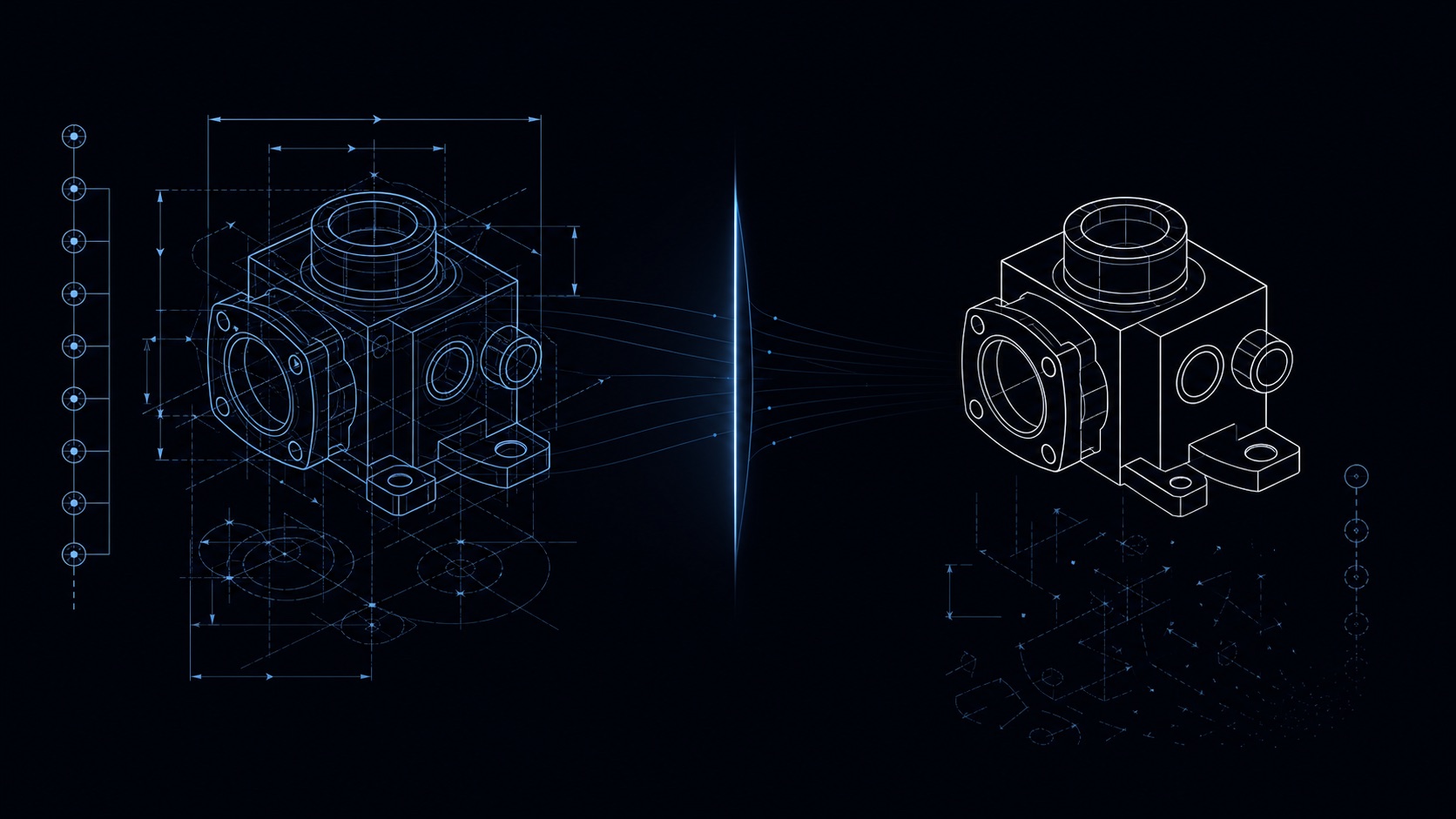
Why We Are Building AI CAD
Engineers know what they want to make. The slow part is translating it into CAD commands. That translation is what we are trying to remove.
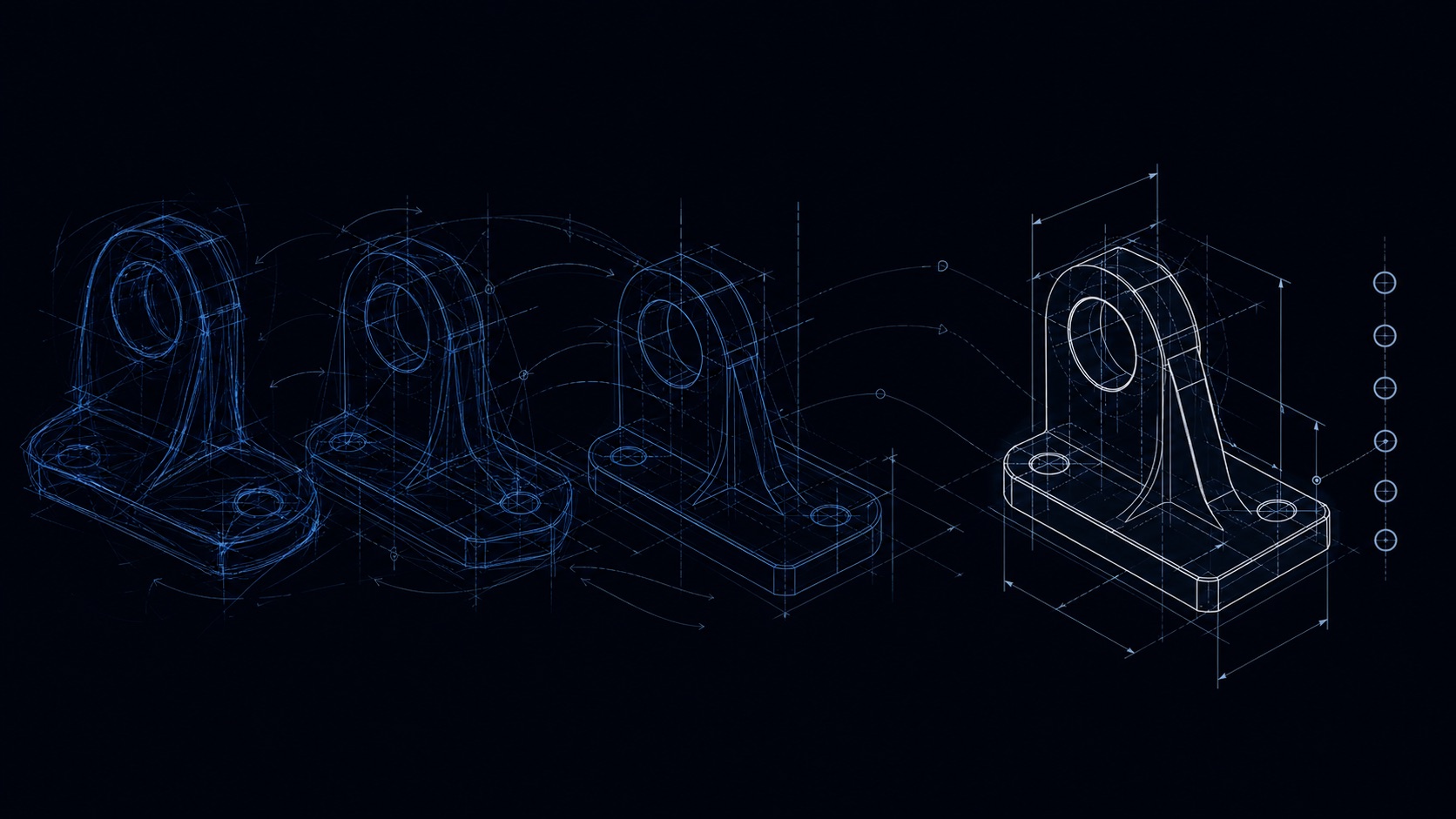
I want to explain, in plain terms, what we are building and why.
zCAD has two parts. zCAD.Online is browser-based parametric mechanical CAD. zCAD.AI is the part we are still building, and it is the reason the company exists. This post is about why.
CAD is hard to use, and that costs the world designs
Think about a simple part. A flat bracket, two mounting holes, one bend.
You know what it looks like the moment you imagine it. It takes you about two seconds.
Now make it in CAD. You pick a plane. You draw a rectangle. You add dimensions so the rectangle stops moving. You extrude it. You pick a face. You draw two circles. You dimension the circles from the right edges. You cut them. You select an edge and add a bend. If you picked the wrong plane at the start, some of that has to be redone.
None of those steps are the design. The design was finished in the first two seconds. Everything after that is translation — converting something you already decided into the specific sequence of operations the software understands.
That translation is why CAD takes months to learn and why experienced engineers still spend so much of the day on it. And it has a real cost: the number of people who can turn an idea into a manufacturable part is much smaller than the number of people who have ideas worth making.
Why CAD ended up this way
It is worth saying that CAD is not badly designed. It is designed for a constraint that no longer fully applies.
When parametric modeling was invented, the computer could not infer anything about your intent. It had no way to know that two holes should stay concentric, or that a wall should stay 2 mm thick when the part gets longer. So the software asked you to state all of it explicitly, one relationship at a time. That was the right decision. Being able to say "these stay concentric" and have it hold through every later change is genuinely powerful, and it is why parametric CAD beat the drafting tools that came before it.
The cost of that decision was the interface. Everything you know has to be entered by hand, in the software's vocabulary, in a valid order. Decades of features were then added on top of that foundation, each one useful, each one another thing to learn.
So we ended up with tools that are extremely capable and extremely demanding. The capability is real and worth keeping. The demand is what we think can change now.
The gap we want to remove
So the goal is simple to state. You should be able to describe what you want, and get the part.
Not a picture of the part. The part — a real model with exact dimensions, one you can hand to manufacturing.
That is the whole idea. Everything else we do is in service of it.
It is worth being clear about what "describe what you want" has to mean, though, because it is not just naming a shape. Engineers do not think in shapes alone. They think in requirements: this has to bolt to that existing plate, it has to clear this moving arm, it has to be stiff enough in this direction, it has to be injection-mouldable. A useful system has to work at that level, and has to be able to ask when the requirement is ambiguous, the same way a competent colleague would ask rather than guess.
Why a picture is not enough
This is the part that makes it hard, and it is where a lot of "AI 3D" work stops being useful for engineering.
There are already tools that generate 3D shapes from a description. What they produce is usually a mesh — a surface made of thousands of tiny triangles. It looks right. You can render it, and you can often 3D print it.
But you cannot engineer with it.
A mesh has no dimensions you can change. If the hole needs to move 3 mm, there is no hole to move — there are only triangles that happen to form a hole-like void. There is no "wall thickness" to adjust, because thickness was never a parameter. Nothing recorded why the shape is the way it is. A cylindrical bore is not a cylinder, it is a many-sided prism, so every measurement you take from it is slightly wrong.
Real engineering work is mostly revision. The first version is never the last one. Design review changes something. Manufacturing pushes back on a draft angle. A supplier's stock size shifts. A tolerance study says a clearance is too tight. A part that cannot be revised is not much use, no matter how good it looks.
So the target is harder than generating a shape. It is generating a parametric model: one with real sketches, real dimensions, real features, and a history you can go back into and change. That is what an engineer can actually work with, and that is what we are aiming at.
Why that is genuinely difficult
I do not want to make this sound easy, because it is not, and I would rather be straight about the difficulty than quietly imply we have solved it.
Generating a picture is a problem with enormous tolerance for error. If a rendered image is slightly wrong, a human looks at it and moves on. Generating a manufacturable model has almost none. A face that does not close, a fillet radius larger than the material it sits on, two features that conflict — any one of those makes the result unusable rather than approximately right.
It is also a different kind of output. A parametric model is closer to a program than to an image: an ordered sequence of operations that has to execute successfully, where each step depends on geometry produced by the steps before it. Reference the wrong face and the whole thing fails to rebuild. Get the order wrong and you get valid geometry that is not the shape anyone wanted.
And the answer has to be checkable. "Looks about right" is not a standard anyone can build to. The output has to hold up to measurement, to interference checks, to whatever the manufacturing process actually requires.
This is why we treat it as a hard engineering problem with a long runway, rather than something that falls out of pointing a general-purpose model at CAD files.
The other half: where the model lives
There is a second reason we started with browser-based CAD rather than jumping straight to the AI part.
Suppose you generate a part. Where does it go?
In traditional CAD, the answer is: it becomes a file. Then someone emails the file, someone else saves a copy, and a week later nobody is sure which copy is current. Every engineering team has a folder with names like housing_final_USE_THIS.step. Adding an AI that produces more files would make that worse, not better — generation is fast, so it would produce them faster than anyone could keep track of them.
There is a second reason the foundation matters. If a model is generated rather than hand-built, the question "where did this come from and who checked it?" gets more important, not less. You want the request, the result, the revisions, and the review to sit in one place, attached to the same thing. That is version history and review — the boring infrastructure — and it becomes more valuable when part of the work is automated.
So zCAD.Online connects modeling, assemblies, drawings, review, versions, permissions, and collaboration around one cloud project. When something is generated, it lands in a place that already knows how to version it, review it, and share it. That foundation is not exciting, but the AI part is much less useful without it.
Where we actually are
I want to be honest about the current state, because this is an area where it is easy to overclaim.
zCAD.AI is in development. There is an interactive preview in the browser that shows the interaction we are building toward — describing what you want, seeing it planned and visualized, revising it. That preview is a simulation. It is not production CAD generation. It is not connected to real accounts, storage, or output.
We published it because showing the interaction is more honest than describing it with adjectives. But a demonstration is not a shipped feature, and I do not want anyone to read it as one.
zCAD.Online is the real product today. It is browser-based parametric CAD, and it is where the work happens now.
What we are actually trying to do
Make the distance between having an idea and having a manufacturable part as short as possible — without giving up the precision and editability that make a model worth anything.
If that works, the interesting consequence is not that existing engineers go faster, although they should. It is that the set of people who can produce a real, manufacturable design gets larger. Right now that set is bounded by who has had the time to learn a demanding tool, not by who has a good idea and understands their problem. Those are not the same group, and the gap between them is full of things that never got made.
That is the whole goal. We will write here about the progress, including the parts that do not work yet.
— Xin Zhou, cofounder, zCAD.ai